
Internal Family Systems (IFS) in Burnaby
In person | Virtual across BC · Updated October 2026

Updated: October 2026
Internal Family Systems (IFS) is a therapy approach that helps you understand the different parts of yourself and build a more compassionate relationship with them. At Pham Therapy, we offer IFS-informed therapy in Burnaby, BC, and virtually to clients across British Columbia.
Most of us already describe our inner world this way without thinking about it. You might say “part of you wants to take a break, even though another part feels guilty the moment you slow down.” IFS calls these different inner voices parts. Each one has its own feelings, beliefs, and role, and many of them developed early in life as ways of coping with what you were going through.
Internal Family Systems (IFS) views every part as having a positive intention, even when its way of helping causes distress. As parts feel heard and understood, they may become less protective, allowing greater access to Self: the capacity for calm, curiosity, compassion, and clarity that IFS recognizes in everyone.
On this page
What is Internal Family Systems (IFS)?
Internal Family Systems (IFS) is a parts-based approach to therapy that understands the mind as naturally made up of different parts. Each part can carry feelings, beliefs, memories, and urges, often taking on roles shaped by your life experiences. In IFS, having different parts is understood as a normal part of being human.
IFS also recognizes Self: a core presence characterized by qualities such as calm, curiosity, compassion, and clarity.
Within this approach, everyone has access to Self, although it can feel difficult to connect with when parts are overwhelmed or protective. Therapy helps you access these qualities and build more trusting relationships with your parts.
The IFS framework

IFS sessions focus on getting to know your parts with curiosity. Instead of trying to argue with a critical voice or push away an uncomfortable feeling, we turn toward it and learn what it is doing and why.
In practice, this work often includes:
Noticing a part through a thought, feeling, or sensation in your body
Getting curious about what it is worried would happen if it stopped its job
Understanding the more vulnerable parts it may be protecting
Helping those parts release the painful beliefs or emotions they have been carrying
The pace is guided by what your system is ready for. Protective parts are treated with respect, and we work with their permission.
Types of Parts in IFS
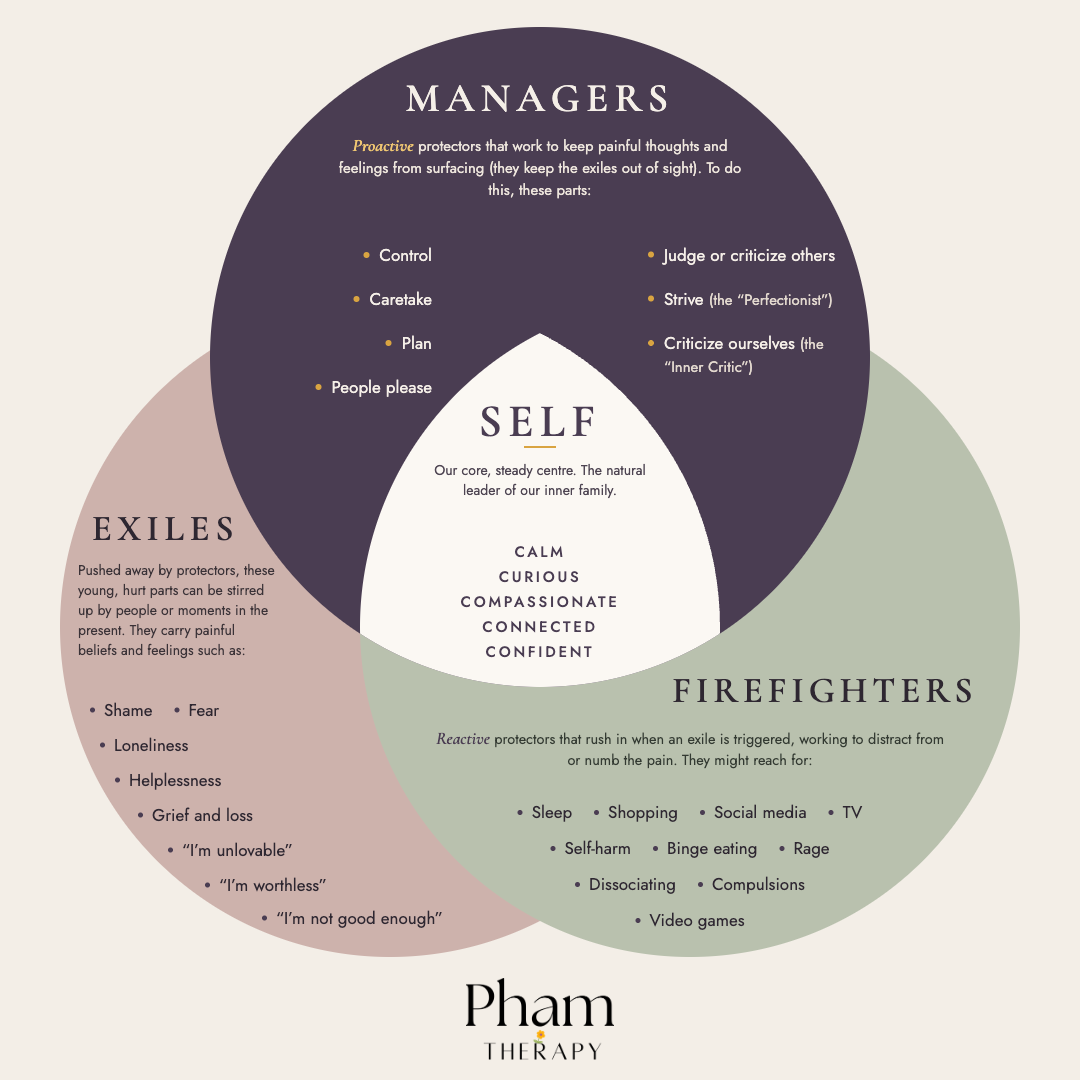
IFS describes a few common kinds of parts.
Managers. Proactive protectors that try to keep you safe and in control. They may show up as planning, perfectionism, self-criticism, people-pleasing, or always staying busy.
Firefighters. Reactive protectors that step in when painful feelings break through. They may show up as numbing out, bingeing, scrolling, shutting down, or sudden anger.
Exiles. Younger, more vulnerable parts that carry hurt, fear, or shame from earlier experiences. Protective parts often work hard to keep these feelings out of awareness.
Self. The steady centre underneath it all. IFS often describes Self through qualities like calm, curiosity, compassion, clarity, confidence, courage, creativity, and connectedness.
What parts carry: burdens and unburdening

In IFS, a burden is a painful belief, emotion, or sensation that a part takes on from difficult experiences. A part might carry the belief “I’m too much,” a heavy sense of shame, or a constant feeling that something bad is about to happen. A burden is something a part picked up along the way, often at a time when you had few other ways to cope, and it can be set down.
Legacy burdens are burdens passed down through families, cultures, and generations. They can come from what parents, grandparents, and communities lived through, such as migration, war, poverty, racism, or loss. They often show up as unspoken family rules: work hard and don’t complain, keep problems private, success is how you earn love. Many of these beliefs once helped people survive, and they can still shape how we feel and act long after the original circumstances have changed.
Unburdening is the process of helping a part release what it has been carrying. Once a part feels understood and safe, it can let go of the old beliefs or emotions it took on. This often brings a sense of relief or lightness, and the part is free to take on a role that fits who you are now. With legacy burdens, unburdening can also be a way to honour what your family endured while choosing what you want to carry forward.
What IFS can help with

IFS is used to support a range of concerns, including:
Perfectionism and harsh self-criticism
Shame and low self-worth
People-pleasing and difficulty setting boundaries
Inner conflict and feeling torn

Who IFS tends to fit
IFS often fits people who notice strong inner conflict, or a critical voice that feels hard to quiet. It suits people who understand their patterns intellectually and want to work with them at a deeper, more emotional level.
IFS can also be a meaningful fit for exploring family and cultural history, especially for first- and second-generation clients navigating patterns passed down through their families.
Depending on what you bring in, we may weave IFS together with ACT, CBT, DBT, or somatic practices.
Internal Family Systems (IFS) therapy is collaborative and experiential, helping you understand your inner world with curiosity and compassion. Sessions focus on getting to know your parts, understanding the roles they have taken on, and connecting with Self so you can respond to your experiences with greater clarity and choice.
Your First IFS Session
The first session is an opportunity for us to begin getting to know you. We may talk about what brought you to therapy, what has been feeling difficult, and what you would like support with.
We may also explore:
Patterns or reactions that feel hard to change
Inner voices that feel critical, anxious, or conflicted
How you have been coping so far
Relationships and family experiences that feel important
What you would like to be different
You do not need to know anything about IFS before starting. If it seems like a good fit, I will introduce the idea of parts and explain how we might work with them.
What Internal Family Systems Therapy sessions look like.
What ongoing IFS sessions may include
Internal Family Systems (IFS) therapy invites you to slow down and notice your inner experience. You might explore thoughts, emotions, body sensations, or images. Some people find it helpful to close their eyes; others prefer to keep their eyes open and talk through what they notice.
Getting to know a part
We may begin with a recent experience, a strong reaction, or a recurring thought. Together, we get curious about the part connected to it: what it feels, what it wants you to understand, and what it may be trying to do for you.
Building trust with protectors
Protective parts may work hard to prevent pain, rejection, or overwhelm. We take time to understand their concerns and the roles they have taken on. Rather than rushing toward painful experiences, we work with protectors to establish trust and a sense of readiness.
Connecting with vulnerable parts
With protectors’ permission, we may connect with parts carrying hurt, fear, shame, or loneliness, sometimes linked to earlier experiences. The focus is on helping these parts feel heard and supported
The Overall Goal of IF
The goal of Internal Family Systems (IFS) therapy is to help you build a more compassionate relationship with your parts and access the calm, clarity, and confidence of Self. As parts heal and find relief from protective roles or painful burdens, you can experience greater inner harmony and respond to life with more flexibility and choice.
Work with us
Pham Therapy | Rachel Pham, RCC #23089
3292 Production Way, Suite 501, Burnaby, BC V5A 4R4 (Production Way - University Skytrain Station)
Contact us
Sessions 50 minutes, $155 · 75 minutes, $230
Format In person in Burnaby, or online across British Columbia
Direct billing Available [· ICBC counselling accepted, no referral needed]
Availability No waitlist
Hours Monday and Friday, 8am to 6pm · Wednesday, 9am to 5pm
Commonly Asked Questions
What can IFS therapy help with?
IFS offers a way to explore self-criticism, conflicting feelings, emotional overwhelm, and recurring relationship patterns. It is also used in trauma work, with attention to the protective responses that developed around painful experiences.
How is IFS different from other types of therapy?
IFS focuses on how you relate to different parts of yourself. For example, rather than only working to change a self-critical thought, we may explore the part expressing it, what it fears, and what it hopes to accomplish. The goal is to create understanding and change through a more compassionate relationship with your inner experience.
Do I need to have experienced trauma to benefit from IFS?
No. You can explore IFS without identifying a trauma history. Therapy can begin with a current concern, such as difficulty setting boundaries, feeling pulled between competing needs, or being hard on yourself.
What if the idea of “parts” feels unfamiliar?
You do not need to arrive knowing how to identify or talk to parts. We can start with familiar experiences, such as “part of me wants closeness, but another part wants to pull away.” Together, we explore whether this way of understanding your experience feels useful to you.
Is IFS therapy supported by research?
IFS has an emerging research base. Preliminary studies suggest potential benefits for depression, trauma-related symptoms, and self-compassion, though larger, well-controlled studies are needed to establish its effectiveness for specific conditions.
Can IFS therapy be done online?
Yes. IFS can be offered in virtual sessions through conversation and guided attention to thoughts, emotions, and body sensations. We work together to find a pace and format that feel comfortable for you.
How long does IFS therapy take?
There is no fixed timeline. The length of therapy depends on your goals, the patterns you want to explore, and your individual needs. We check in regularly about your progress and whether the work is helping.