
Acceptance and Commitment Therapy (ACT) in Burnaby
In person | Virtual across BC · Updated September 2026

Updated: September 2026
Acceptance and Commitment Therapy (ACT) is an evidence-based therapy that helps you make room for difficult thoughts and feelings while taking action toward what matters to you. At Pham Therapy, we offer ACT in Burnaby, BC, and virtually to clients across British Columbia.
Most people arrive having already tried hard to think their way out of anxiety, self-criticism, or grief.
ACT takes a different route. It loosens the grip those thoughts have on you so they stop steering your choices, and it puts your attention on the life you actually want to be living.
The approach was developed by Steven C. Hayes in the 1980s and now has a substantial research base across anxiety, depression, OCD, trauma, and chronic pain.
What is Acceptance and Commitment Therapy?
Acceptance and Commitment Therapy is an evidence-based approach that helps people work with anxiety, depression, trauma, and other difficult experiences by building psychological flexibility: the capacity to stay present with hard thoughts and feelings while continuing to act in line with what matters most.
Psychological flexibility is the whole point of the model. When it's low, life narrows. You start organizing your days around what you're trying to avoid, and the things you care about quietly fall off the list. When it grows, difficult thoughts still show up, and they take up less room in the driver's seat.
How the ACT framework works

ACT teaches practical skills like mindfulness and acceptance so you can handle difficult thoughts and feelings without getting stuck in them. It also supports you in identifying your values and taking small, meaningful actions toward the life you want.
In practice, sessions move between two kinds of work.
One is about your relationship to your inner experience, learning to notice a thought as a thought rather than a fact you have to obey.
The other is about direction, getting specific about what you care about and what a step toward it looks like this week.
The six core processes of ACT
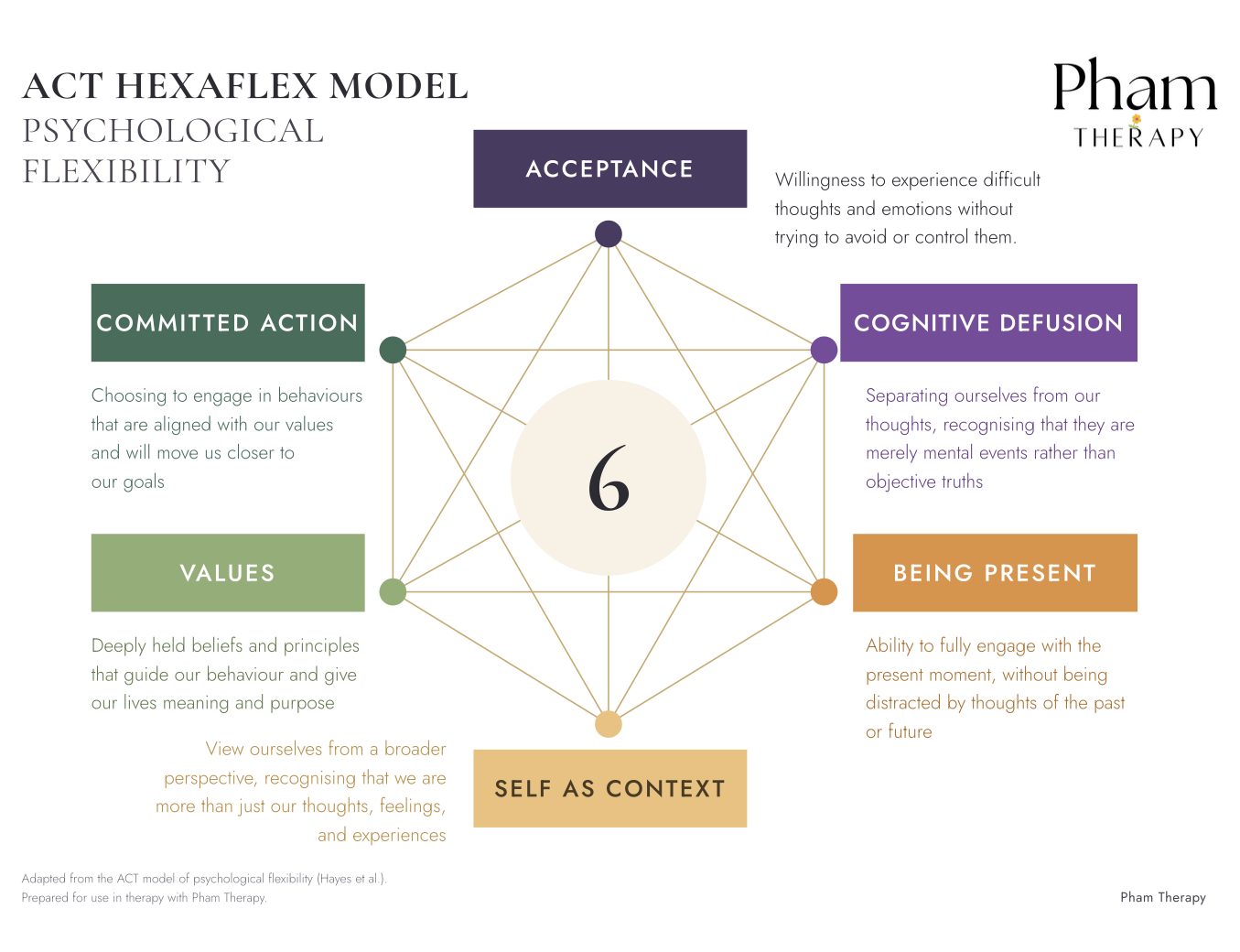
ACT is often mapped as a hexagon, sometimes called the hexaflex. The six processes work together rather than in sequence.
Acceptance. Making room for difficult thoughts and feelings instead of struggling to suppress or avoid them.
Cognitive defusion. Noticing thoughts as passing mental events you can observe with some distance.
Present-moment awareness. Staying grounded in what's happening right now, with less pull toward rumination or worry.
Self-as-context. Developing a stable sense of yourself that holds steady underneath changing thoughts, moods, and roles.
Values. Getting clear on what genuinely matters to you, in your own words, separate from what you think you should want.
Committed action. Taking concrete steps in the direction of those values, adjusting as you go.
What ACT can help with

Research supports the effectiveness of Acceptance and Commitment Therapy (ACT) for a range of concerns, including:
Perfectionism and harsh self-criticism
Eating disorders and body image
Burnout and chronic stress
Chronic pain
Grief

Who ACT tends to fit
ACT often lands well with people who feel stuck in overthinking, avoidance, or self-criticism, and who want their days to look different rather than only feeling different. It suits people who have done insight work before and can describe their patterns clearly, yet still find those patterns running the show.
It also blends well with other approaches. Depending on what you bring in, we may weave ACT together with CBT, parts work, or somatic practices.
Acceptance and Commitment Therapy (ACT) is collaborative and flexible. Sessions are shaped by what you are experiencing, what matters to you, and the changes you hope to make in your life.
Your First ACT Session
The first session is an opportunity for us to begin getting to know you. We may talk about what brought you to therapy, what has been feeling difficult, and what you would like support with.
We may also explore:
Situations in which you feel stuck
The thoughts and emotions that tend to arise
How you have been responding or coping
What you would like to be different
The relationships, roles, and parts of life that matter to you
You do not need to arrive with everything figured out. We can take time to understand your experiences together and identify an initial direction for therapy. I may also introduce ACT and explain how it could relate to the concerns you are bringing forward.
What Acceptance and Commitment Therapy sessions look like.
What Ongoing ACT Sessions May Include
There is no single formula for an ACT session. Our conversations may begin with something that happened recently, a recurring pattern you have noticed, or an experience that feels important to explore.
Understanding Your Patterns
We may slow down and look at what happens when a difficult thought, emotion, memory, or physical sensation appears. Together, we can explore how you respond, what that response offers in the short term, and whether it moves you closer to or further from the life you want.
Relating Differently to Thoughts and Emotions
ACT offers practical ways to notice thoughts without automatically treating them as instructions or facts. You may also practise making space for uncomfortable emotions with greater openness and compassion.
This may involve conversation, mindfulness, metaphors, reflection, or brief experiential exercises during the session.
Clarifying What Matters to You
Values are an important part of ACT. We may explore what you want your life and relationships to stand for, especially when anxiety, fear, or self-doubt have made that difficult to see.
Values provide a direction for therapy and help us identify changes that feel personally meaningful to you.
Taking Meaningful Steps
Together, we may identify small and realistic actions that reflect your values. We will explore what could get in the way, how you might respond when difficult internal experiences arise, and what support would make the next step feel possible.
Throughout the process, we will continue reflecting on what is helping, what feels challenging, and how therapy can be adjusted to better support you.
The Overall Goal of ACT
ACT supports the development of psychological flexibility: the ability to remain present with your experiences and choose how you want to respond based on what matters to you.
Over time, you may develop a different relationship with difficult thoughts and emotions while building patterns of action that bring greater meaning, connection, and intention into your life.
Work with us
Pham Therapy | Rachel Pham, RCC #23089
3292 Production Way, Suite 501, Burnaby, BC V5A 4R4
Contact us
Sessions 50 minutes, $155 · 75 minutes, $230
Format In person in Burnaby, or online across British Columbia
Direct billing Available [· ICBC counselling accepted, no referral needed]
Availability No waitlist
Hours Monday and Friday, 8am to 6pm · Wednesday, 9am to 5pm
Commonly Asked Questions
How is ACT different from CBT?
Both are well-researched and often overlap in practice. CBT tends to focus on identifying and changing unhelpful thought patterns directly. ACT takes a different route, working on your relationship to those thoughts so they carry less weight, while helping you commit to action that reflects your values regardless of what your mind is telling you in the moment. Many people benefit from a blend of both, which is often how we work at Pham Therapy.
Is ACT evidence-based?
Yes. It has a substantial and growing research base, including support for anxiety, depression, OCD, trauma-related difficulties, and chronic pain. It's considered one of the major approaches within the broader cognitive-behavioural therapy family.
Do I need a formal diagnosis to start?
No diagnosis required. Many people come to ACT because they feel stuck in patterns of avoidance, overthinking, or self-criticism, whether or not that fits a clinical label.
How long does ACT therapy take?
There's no fixed timeline. Some people come for a focused block of sessions to build specific skills, others stay longer to keep reinforcing new patterns. We check in regularly about what's working and adjust from there.
What if I've tried therapy before and it didn't help?
That's a common and valid starting point. Fit matters as much as the approach itself, both with your therapist and with the method. We'll take time to understand what has and hasn't worked before and build from there.