
8 Grounding Exercises to Settle an Overwhelmed Nervous System
When emotions run high, advice like "just breathe" can feel almost insulting. So before the exercises, one important truth:
Coping skills are not about making feelings go away. They are about helping your body feel safe enough that the feeling can move through you instead of taking over.
First, a little about how this works
Your nervous system has a comfortable range where you can feel emotions and still think clearly. Therapists sometimes call this the window of tolerance (Siegel, 1999). Inside the window, you can be sad, frustrated, or nervous and still stay connected to yourself and the people around you.
Your nervous system has a comfortable range where you can feel emotions and still think clearly. Therapists sometimes call this the window of tolerance (Siegel, 1999). Inside the window, you can be sad, frustrated, or nervous and still stay connected to yourself and the people around you.
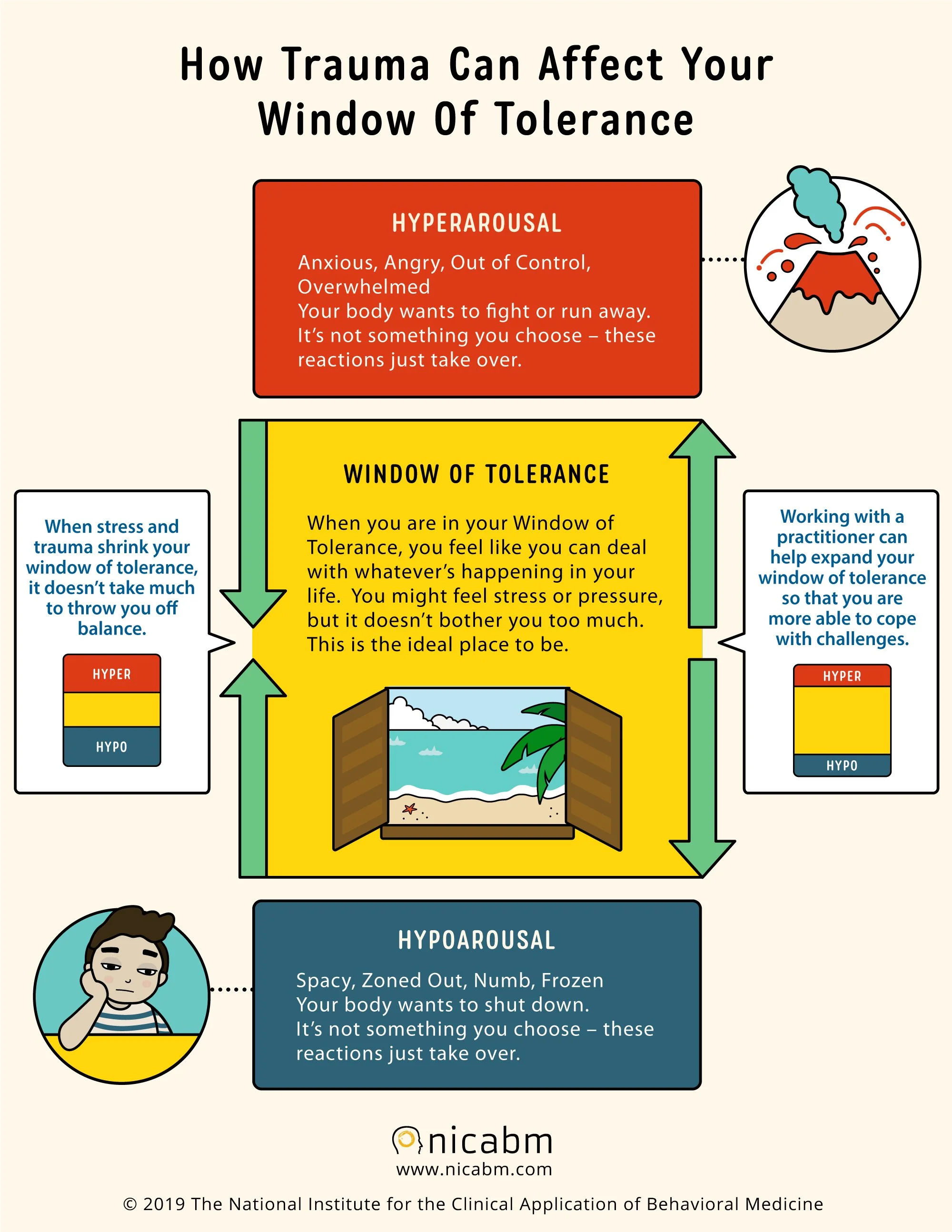
Infographic: NICABM (nicabm.com)
Exercises
Coming back to the present
These help when your mind has been pulled into a spiral, a memory, or a worry, and you need to return to the room you are actually in. Attention is like a spotlight, and these exercises give it somewhere concrete to shine.
1. The 5-4-3-2-1 practice. Name five things you can see, four you can hear, three you can touch, two you can smell, and one you can taste. Working through the senses one by one gives your mind a task that can only be done in the present.
2. Feel your feet. Press both feet firmly into the floor. Notice the contact, the weight, the support underneath you. When the mind races, the body is an anchor, because your body only ever exists in the present moment.
Settling the body directly
Emotions are not just thoughts. They are heartbeat, breath, temperature, and muscle. These exercises speak to your nervous system in its own language, which is why they can work even when reasoning with yourself does not.
3. Lengthen your exhale.Breathe in for four counts and out for six. Your exhale is wired to the branch of your nervous system responsible for settling, so a longer out-breath is a direct message to your body that the emergency is easing. Research shows slow breathing measurably reduces physiological arousal (Zaccaro et al., 2018).
4. Cool water on your hands. Run cool water over your wrists and notice the temperature. Strong, safe sensory input gives your body a new signal to organize around, interrupting the alarm without fighting it.
5. Move the energy. Intense emotion is your body mobilizing, preparing you to act. When there is nothing to act on, that charge needs somewhere to go. A brisk walk around the block, ten slow shoulder rolls, or pushing your palms firmly against a wall completes the cycle your body started.
Creating space before responding
Between what happens and what you do next, there is a gap. Under stress that gap can shrink to almost nothing. These skills widen it, and even a few seconds of space can change the outcome of a hard moment.
6. Name the feeling. Silently say to yourself, this is anger or this is hurt. It sounds too simple to work, but naming a feeling recruits the thinking parts of your brain, and studies show that putting feelings into words reduces activity in the brain's alarm system (Torre & Lieberman, 2018). You cannot regulate what you have not named.
7. The pause sentence. Before responding to something upsetting, try saying, I need a moment before I answer that. This is not avoidance. It is a boundary with your own reactivity, and it protects both you and the relationship.
Offering yourself kindness
This category is the one people skip, and often the one they need most. If your inner voice turns harsh the moment you struggle, your body reads that harshness as one more threat, and the alarm continues. Compassion is not indulgence. It is regulation.
8. The self-compassion hand. Place a hand over your heart, or wherever feels comforting, and take three slow breaths. It may feel unfamiliar at first, especially if kindness toward yourself is new territory. But soothing touch activates the parasympathetic nervous system, the part of the body that calms stress and restores balance, and research shows self-compassion practice meaningfully reduces distress over time (Neff & Germer, 2013). If you'd like a guided version, Dr. Kristin Neff offers a free supportive touch exercise on her website, including different placements to try, since what feels comforting varies from person to person.
When coping skills are not enough
If you practice these and still find yourself overwhelmed more often than not, that is not a failure. It usually means the overwhelm has deeper roots, in long-term stress, in anxiety, or in experiences your body still carries. Coping skills help you through the moment. Therapy helps you understand why the moments keep coming. Both matter, and you deserve both.
For more tools, visit our emotions resources page, or book a free consultation to learn how therapy can support you.
About the author
Rachel Pham, RCC is a Vietnamese-Canadian Registered Clinical Counsellor and the founder of Pham Therapy in Vancouver, offering trauma-informed, culturally responsive therapy in person and online across BC. She draws on ACT, /DBT-informed, somatic, IFS, and attachment-based approaches, and brings both clinical training and lived understanding to her work. Her registration can be verified with the BC Association of Clinical Counsellors.
Disclaimer: This content is for general information only and does not constitute medical or psychological advice or replace care from a qualified professional.
References
Neff, K. D., & Germer, C. K. (2013). A pilot study and randomized controlled trial of the mindful self-compassion program. Journal of Clinical Psychology, 69(1), 28–44. https://doi.org/10.1002/jclp.21923
Torre, J. B., & Lieberman, M. D. (2018). Putting feelings into words: Affect labeling as implicit emotion regulation. Emotion Review, 10(2), 116–124. https://doi.org/10.1177/1754073917742706
Zaccaro, A., Piarulli, A., Laurino, M., Garbella, E., Menicucci, D., Neri, B., & Gemignani, A. (2018). How breath-control can change your life: A systematic review on psycho-physiological correlates of slow breathing. Frontiers in Human Neuroscience, 12, 353. https://doi.org/10.3389/fnhum.2018.00353
